
The majority of trail camera photos captured of cougars in the Upper Peninsula have been of solitary animals, which are usually males, but Dayne Pulkas from Trimountain got about a dozen pictures of a pair of mountain lions together at one of his deer baits in Ontonagon County on November 10 this year.
It’s possible the pictures are of one of the pair of cougar kittens seen and photographed in Ontonagon County this spring, along with their mother. The cat facing the camera in an image of the pair on apples put there for the deer appears to be a juvenile. The cougar smelling the apples appears larger.
Both cats could be juveniles, however, and their mother may not have been with them at the time. Young cougars typically stay with their mothers for 18 to 24 months, according to the Internet, but mother and young aren’t always in the same place.
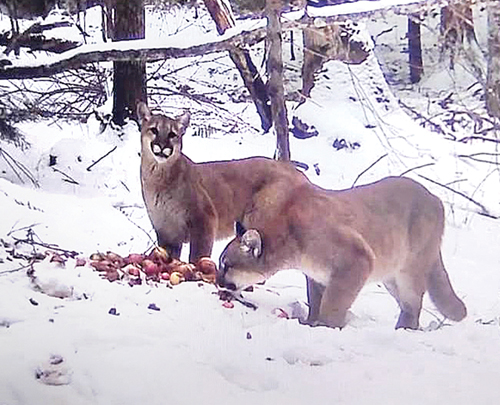
Dayne Pulkas trail cam photos of two cougars from Trimountain.
Female cougars can have litters of up to 4 kittens, but the survival rate of young cats is low. The average number of kittens that survive from lion litters is one, according to the Internet.
“The date on the pictures is off by about a month,” Pulkas said. “We got some snow during the first part of November, and that’s when the pictures were taken. I threw some apples out to see if any deer were in the area near Twin Lakes. The cats were the first animals I got on camera.”
In one of the photos, it looks like one of the lions might be eating an apple, but it was probably simply smelling them. According to the Internet, mountain lions eat only meat, not fruits like apples.
Although the pictures captured by one of Pulkas’ cameras at a deer bait are the most dramatic and noteworthy since they are the first images of multiple cats, they don’t represent the first time he’s known about their presence near where he lives. He saw his first mountain lion in the UP when he was in high school around 2006. The animal crossed a road in the headlights of his vehicle and disappeared in a roadside ditch.
“There’s no other animal that has a tail like a mountain lion,” he said. “I knew what I saw. I have seen their tracks in the woods multiple times over the past few years. I tend to see their tracks on logging roads.”
About a week after his camera captured photos of the pair of lions investigating apples he left for deer, he had a set of cougar tracks in his tracks when he was coming out of the woods. This happened about a quarter mile from where the cougars were photographed.
“Seeing those tracks made me spend more time looking around when I’m in the woods,” Dayne commented. “Knowing that wolves are in the woods never intimidated me. I’m more concerned about the presence of mountain lions.”
Part of the reason Pulkas had a cougar following his tracks is that he always drags a scent rag behind him when he’s deer hunting. He drags a rag soaked with Code Blue scent, a scent that’s attractive to bucks looking for does. One year, Dayne bagged a pair of trophy bucks with 8 and 10-point antlers by dragging a scent rag, and that’s why he continues to do so.
“I have had a lot of critters following me when dragging a scent rag,” Pulkas explained. “It’s not always what you want.”
There are many old mines in the area where Dayne deer hunts. He commented that lions could use those mines as dens. Those refuges may be why cougars are attracted to that area and seem to be reproducing.
A male cougar was struck by a vehicle in northern Houghton County south of Twin Lakes on the evening of November 15, according to DNR wildlife biologist Brian Roell at the Marquette office.
“No carcass was recovered from that cougar,” he said. “We made an effort to find the animal, but were not able to. We did recover some hair and part of a claw from that animal. Based on DNA examination, the lab was able to determine it was a male.”
Roell said there have been 29 confirmed cougar reports so far during 2025 compared to 23 during 2024. He added that there has been a steady increase in confirmed reports of lions in the UP since 2019. The 29 reports from 2025 do not include the pictures Pulkas got. Roell said Dayne did not want to report his experience because the DNR would have had to visit the site where the photos were taken to confirm their authenticity.
“Confirmed reports are up again this year,” Roell explained, “but you have to take that with a grain of salt. The number of trail cameras that are out there now is also much higher. The DNR alone has 1,300 cameras out there monitoring all types of wildlife. The increase in confirmed cougar reports coincides with the increase in the use of trail cameras.”


